
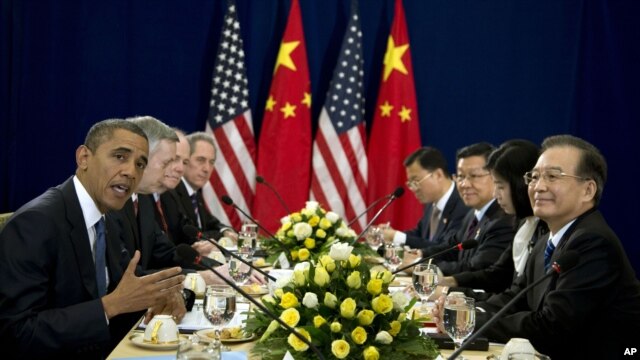
U.S. President Barack Obama (L) speaks as he meets with Chinese Premier
Wen Jiabao (R) during the East Asia Summit at the Peace Palace in Phnom Penh, Cambodia,
November 20, 2012.
PHNOM PENH — On the final day of his Southeast
Asia trip, President Barack Obama met with Chinese Premier Wen Jiabao and
Japanese Prime Minister Yoshihiko Noda on the sidelines of the East Asia Summit
in Phnom Penh, Cambodia
It was the first meeting between the president and Premier Wen since
their talks at the last East Asia Summit in Bali last year and since Obama's
re-election to a second term. The two have met five times in all.
As the two largest global economies, the president says China and the United
States have a special responsibility to lead the way to ensure sustained and
balanced global economic growth.
"It is very important that as two of the largest economies in the world,
that we work to establish clear rules of the road internationally for trade and
investment, which can increase prosperity and global growth," said Obama.
Premier Wen congratulated Obama on his re-election and spoke about the
importance of a strong Sino-American relationship, calling it important for
peace, stability and prosperity in the Asia-Pacific region and the world.
In describing the talks to reporters, Deputy National Security Adviser Ben
Rhodes offered additional specifics, noting that meeting was the last the two
will have, given leadership changes in China.
"They discussed the importance of the U.S. and China consistently
maintaining our cooperation on a bilateral and global level. They
discussed security issues including Iran. They discussed economic issues,
including our commitment to strengthen the rules of the road in the global
economy,” said Rhodes. “And, they discussed regional stability,
reaffirming that China is part of our engagement here in this important region
a critical part of that engagement, and our interest again in resolving
territorial disputes and maritime disputes consistent with international rules
of the road."
In his only other bilateral meeting at the East Asia Summit, President Obama
met with Prime Minister Yoshihiko Noda of Japan.
Those discussions focused on the U.S. - Japan alliance. Washington has
urged Tokyo and Beijing to resolve tensions about disputed islands in the East
China Sea.
Although there were expectations Japan would announce it is joining the
Trans-Pacific partnership, a new free trade initiative, Rhodes says that
did not happen.
Obama's Southeast Asia trip has enabled him to fill in more details of the U.S.
economic and security shift to the Asia-Pacific region, of which nations in the
Association of Southeast Asian nations (ASEAN) are a crucial part.
He addressed the shift toward the end of his speech in Rangoon, Burma.
"The United States of America is a Pacific nation. We see our future as
bound to those nations and peoples to our West,” he said. “As our economy
recovers, this is where we believe we will find tremendous growth. As we end
the wars that have dominated our foreign policy for a decade, this region will
be a focus of our efforts to build a prosperous peace.”
In their final statement, U.S. and ASEAN leaders say they are elevating the
annual leaders meeting to a summit.


No comments:
Post a Comment
yes